
Parkinson’s Disease: What It Is and How It Affects the Brain
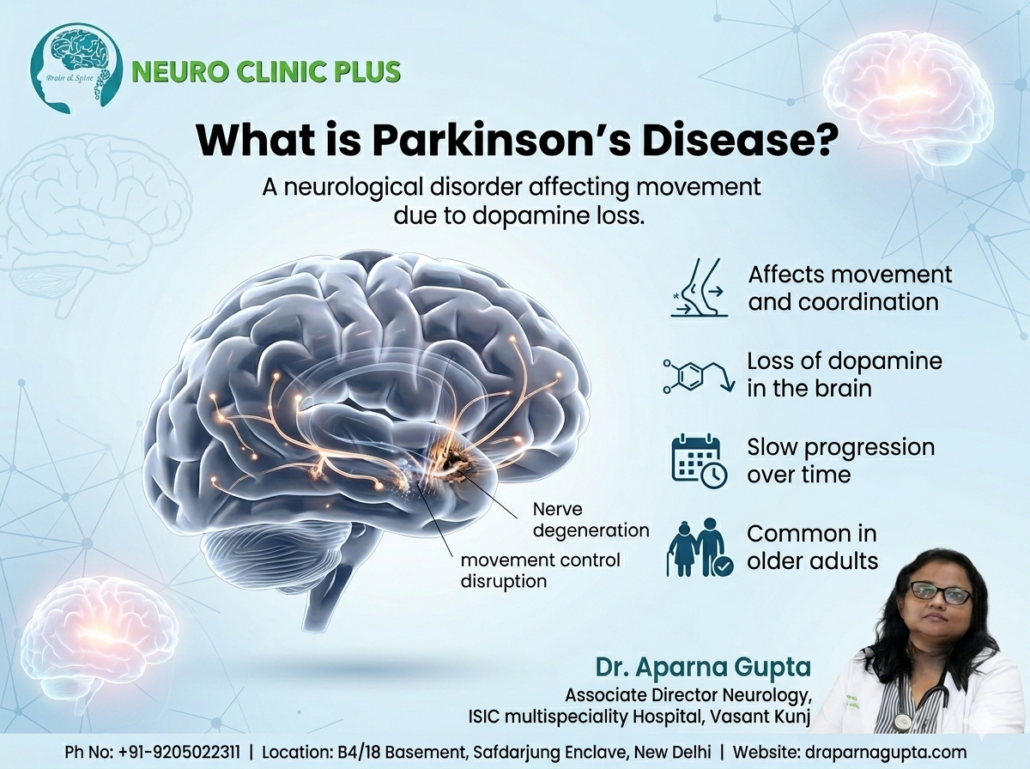
Parkinson’s disease is a long-term condition that affects the brain and gradually changes the way a person moves and controls their body. It is one of the most common neurological disorders seen in adults, especially in older age groups. The disease develops slowly over time, which means the changes in the body are not sudden but happen gradually.
Understanding Parkinson’s disease is important because it helps people recognize what is happening in the brain when movement and coordination begin to change. It is not just a movement disorder but a condition that is linked to changes inside the nervous system.
In simple terms, Parkinson’s disease affects the brain’s ability to send proper signals to the muscles. This results in difficulty in controlling normal body movements over time. Since it progresses slowly, many people may not notice the early changes immediately.
Learning about Parkinson’s disease helps in building awareness and understanding of how the brain works and how certain conditions can affect daily life.
2. Definition of Parkinson’s Disease
Parkinson’s disease is a progressive neurological disorder that affects the central nervous system, especially the parts of the brain responsible for controlling movement. It develops when nerve cells in a specific area of the brain, known as the substantia nigra, gradually become damaged or stop functioning properly. These nerve cells are responsible for producing dopamine, a chemical that plays a key role in coordinating smooth and controlled muscle movements.
As the level of dopamine decreases in the brain, the communication between the brain and the body becomes less efficient. This leads to increasing difficulty in controlling voluntary movements. Because of this gradual loss of brain function, Parkinson’s disease is classified as a progressive condition, meaning it worsens over time.
The disease is not a sudden illness but develops slowly, often over many years. It mainly affects movement control, but its origin lies in changes happening inside the brain’s nervous system.
3. Role of the Brain in Parkinson’s Disease
Dopamine and Its Function
The brain controls all body movements through a complex communication system, and dopamine is one of the most important chemicals involved in this process. In a healthy brain, dopamine acts as a messenger that helps different regions of the brain communicate smoothly. It is especially important for controlling coordinated and controlled muscle movements, allowing the body to perform everyday actions with ease.
Substantia Nigra and Nerve Cells
A specific part of the brain called the substantia nigra is responsible for producing dopamine. This area contains specialized nerve cells that continuously release dopamine to maintain proper movement control. These cells play a crucial role in ensuring that the brain can send accurate signals to the muscles.
Effect of Cell Damage in Parkinson’s Disease
In Parkinson’s disease, the dopamine-producing nerve cells in the substantia nigra gradually become damaged or die. As these cells are lost, dopamine levels in the brain decrease. This disrupts the communication between the brain and the body, making it harder for the brain to control movements smoothly and efficiently over time.
4. How Parkinson’s Disease Develops
Gradual Loss of Nerve Cells
Parkinson’s disease develops when certain nerve cells in the brain slowly begin to deteriorate over time. These cells are responsible for producing dopamine, a chemical that helps control movement. As more of these nerve cells become damaged or die, the brain’s ability to produce enough dopamine gradually decreases.
Slow Progression Over Time
The condition does not appear suddenly. Instead, it progresses very slowly, often over many years. In the early stages, the changes inside the brain are mild and may not be easily noticeable. However, as time passes, the loss of dopamine becomes more significant, and the brain’s movement control system becomes increasingly affected.
Impact on Brain Function
As Parkinson’s disease develops, the communication between the brain and the muscles becomes weaker. The brain finds it harder to send smooth and accurate signals for movement. This ongoing decline in brain function is what makes Parkinson’s disease a progressive neurological disorder, meaning it continues to worsen gradually over time.
5. Who is Affected
Age Factor
Parkinson’s disease is most commonly seen in older adults, especially people above the age of 60. The risk of developing this condition increases with age, as the brain naturally undergoes gradual changes over time. However, it is important to note that Parkinson’s disease is not limited only to elderly individuals.
Younger Individuals
In rare cases, Parkinson’s disease can also affect younger people. When it appears before the age of 50, it is often referred to as early-onset Parkinson’s disease. Although this form is less common, it shows that the condition is not strictly restricted to a particular age group.
General Risk Pattern
While age is one of the biggest risk factors, Parkinson’s disease can affect both men and women. The exact reason why some people develop the condition and others do not is still not fully understood. This makes it a complex neurological disorder that can vary from person to person.
6. Nature of the Disease
Long-Term Condition
Parkinson’s disease is a chronic condition, which means it lasts for a long period of time and continues throughout a person’s life. It does not develop suddenly or resolve quickly, but instead progresses slowly over many years. Because of its long-term nature, it requires continuous attention and care.
Progressive in Nature
The disease is also progressive, meaning its effects on the brain and body gradually increase over time. As more dopamine-producing nerve cells are lost, the condition becomes more noticeable and can increasingly affect a person’s ability to carry out normal activities.
Non-Contagious Disease
Parkinson’s disease is not contagious. It cannot spread from one person to another through physical contact, air, or any form of interaction. It develops due to changes inside the brain rather than external infection.
Impact on Movement System
The main area affected by Parkinson’s disease is the movement control system of the body. Since the brain struggles to send proper signals to the muscles, overall coordination and smoothness of movement are gradually affected over time.
7. Medical Understanding
Exact Cause is Not Fully Known
The exact cause of Parkinson’s disease is still not completely understood. Medical researchers have not identified a single clear reason why dopamine-producing nerve cells in the brain begin to deteriorate. Instead, it is believed to be a combination of different factors that contribute to its development.
Possible Contributing Factors
Although the exact cause is unknown, studies suggest that both genetic and environmental factors may play a role. In some cases, a family history of Parkinson’s disease may slightly increase the risk. Environmental exposure to certain toxins or long-term changes in brain chemistry are also being studied as possible contributing factors.
Ongoing Research
Medical science is continuously researching Parkinson’s disease to better understand how and why it develops. The focus is on identifying the biological changes in the brain that lead to dopamine loss. This research is important for improving diagnosis, treatment options, and future possibilities for prevention.
Complex Neurological Condition
Because the exact cause is unclear and varies from person to person, Parkinson’s disease is considered a complex neurological disorder that involves multiple interacting factors within the brain.
9. Frequently Asked Questions (FAQ)
1. What is Parkinson’s disease in simple words?
Parkinson’s disease is a brain disorder that affects movement. It happens when certain brain cells stop working properly and reduce the production of dopamine, a chemical that helps control body movements.
2. Is Parkinson’s disease a brain disease?
Yes, Parkinson’s disease is a neurological (brain-related) disorder. It mainly affects the part of the brain responsible for controlling movement and coordination.
3. Is Parkinson’s disease curable?
Currently, Parkinson’s disease has no permanent cure. However, it can be managed with medications, therapy, and medical care to improve quality of life.
4. Does Parkinson’s disease get worse over time?
Yes, it is a progressive condition, which means it gradually worsens over time as more brain cells are affected.
5. Who is more likely to get Parkinson’s disease?
It is more common in older adults, especially people above 60 years of age, but in rare cases, it can also occur in younger individuals.
8. Conclusion
Parkinson’s disease is a long-term neurological disorder that affects the brain’s ability to control movement. It develops when dopamine-producing nerve cells in a part of the brain called the substantia nigra gradually become damaged or die. Dopamine is an important chemical that helps ensure smooth and coordinated body movements, so its reduction directly impacts movement control.
As the disease progresses slowly over time, the brain becomes less effective at sending proper signals to the muscles. This leads to increasing difficulty in performing normal physical activities. Parkinson’s disease is not a sudden condition but a gradual process that continues to develop over many years.
It is most commonly seen in older adults, although it can also occur in younger individuals in rare cases. The exact cause is still not fully known, but it is believed to involve a combination of genetic and environmental factors.
Overall, Parkinson’s disease is a complex condition of the nervous system that primarily affects movement, and understanding its basic nature helps in building awareness about how it impacts the brain and body over time.











Leave a Reply
Want to join the discussion?Feel free to contribute!