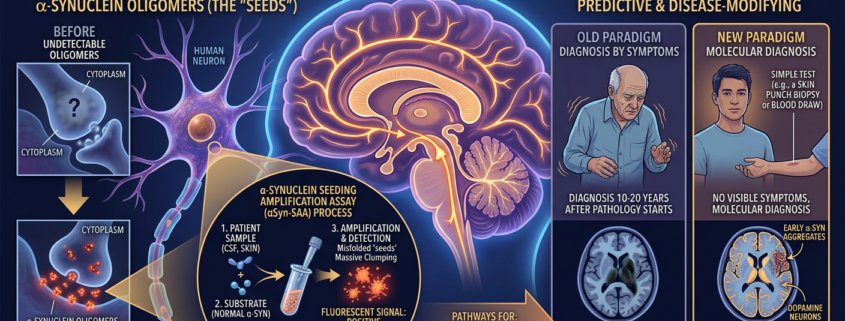
- Link Between Groundwater and Parkinson’s: A new study released in March 2026 found that people consuming “younger” groundwater (from within the last 75 years) may have a higher risk of developing Parkinson’s compared to those using older groundwater. Specifically, water from carbonate aquifers was linked to a 24% higher risk.
- New ‘Gut Panel’ for Precise Diagnosis: Researchers have developed a new diagnostic panel combining gut metabolites and microbial gene markers that can detect Parkinson’s with 96% accuracy.
- Progress in Medications (Tavapadon): AbbVie has submitted an application to the FDA for its new drug, ‘Tavapadon.’ This is a once-daily pill designed to provide better control over symptoms.
- Stem Cell Therapy (Bemdaneprocel): Bayer has launched Phase 3 trials for ‘Bemdaneprocel,’ a stem cell therapy. This therapy aims to replace lost dopamine cells in the brain, representing a major step toward treating the root cause of the disease.
- Controlling Brain Inflammation: Researchers have tested new anti-inflammatory drugs that help stop the “slow fire” (inflammation) in the brain that destroys dopamine cells.
-
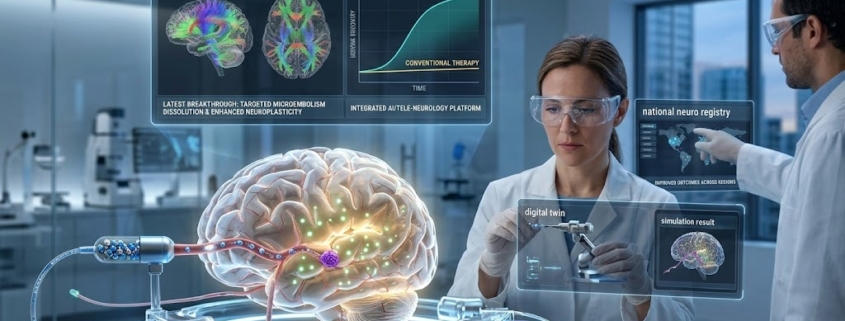
Vagus Nerve Stimulation (VNS): The central display shows a graph comparing the steep improvement of VNS-paired recovery against conventional therapy, emphasizing this FDA-approved breakthrough for motor skills, particularly in the hands and arms, even years after a stroke.
-
Targeted Nano-Therapy: In the brain model, you can see ‘microvascular networks’ where blue-and-silver nanoparticles are targeting a simulated clot and releasing ‘neuroprotective molecules,’ which then begin to glow with a healthy, golden light, visualizing the potential for targeted treatment and enhanced neuroplasticity.
The image captures a modern, optimistic lab environment where researchers are using augmented reality, digital twins, and AI/tele-neurology platforms to develop these advanced, personalized solutions.
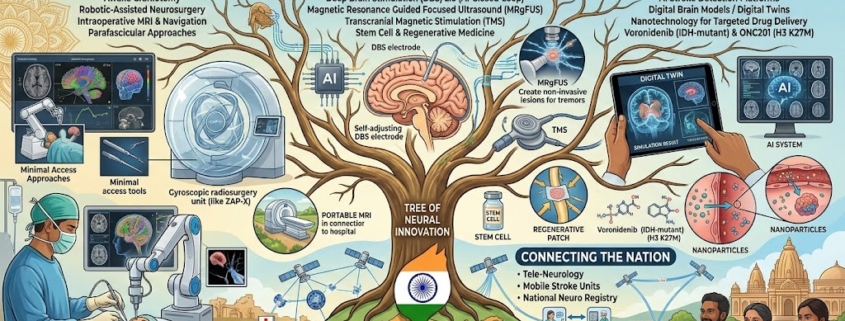
- Indigenous Stroke Treatment Device: In a major breakthrough, AIIMS New Delhi led the successful clinical trial (GRASSROOT) of the ‘Supernova’ stent retriever, an indigenously tested device for removing clots in large vessel occlusion strokes. This device offers a high-quality, 50-70% more affordable, and domestically produced alternative to imported devices, improving access to urgent care.
- Advanced ‘Brain Pacemaker’ (DBS): Deep Brain Stimulation (DBS) has become more sophisticated with the introduction of BrainSense™ technology, which allows for continuous monitoring of brain activity in Parkinson’s patients, enabling doctors to fine-tune treatment in real time. Medanta and Aster Hospitals are utilizing these advanced, patient-specific AI-guided targeting systems for better outcomes in movement disorders, dystonia, and epilepsy.
- Nanomaterial for Non-Invasive Brain Modulation: Indian scientists have developed a new biocompatible semiconducting nanomaterial that can modulate neurons without surgery. This breakthrough holds promise for non-invasive treatment of neurodegenerative diseases like Alzheimer’s and Parkinson’s.
- AI and Robotics in Neuro-Rehabilitation: AI-based imaging analytics are now used to reduce door-to-needle time in stroke cases. Additionally, robotic-assisted therapy and VR-based gamified platforms are increasingly used for post-stroke rehabilitation and cognitive disorders.
- Portable MRI Technology: The adoption of portable MRI units (e.g., Hyperfine Swoop) is revolutionizing stroke and trauma care in ICUs and rural areas, allowing for rapid diagnosis.
- Wearable Mobility Aids: Lifespark Technologies developed ‘WALK’, a wearable, non-invasive neuromodulation device that helps Parkinson’s patients manage gait symptoms and prevent falls
Important Links
Address
Neuro Clinic Plus, B4/18, opposite Iris Park Hotel, B4 Block, Safdarjung Enclave, New Delhi